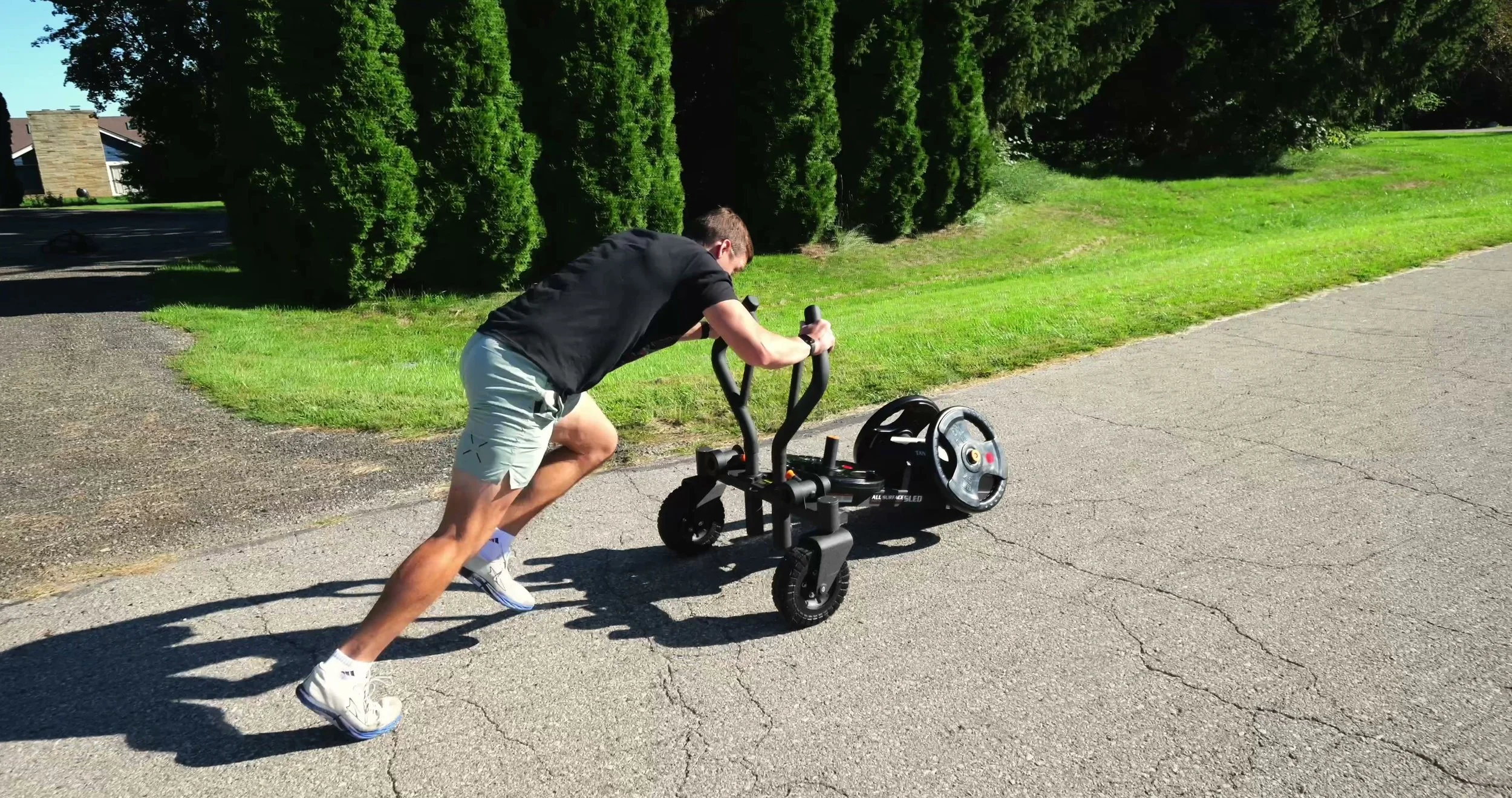
This product was reviewed in house by Michael at the Jungle Gym Reviews.
The Torque TANK M1S is a wheeled, magnetic-resistance sled that I found genuinely useful for outdoor conditioning when a conventional skid sled would be a poor match for my loose-gravel home setup, but its price and always-swiveling wheels make it a more specific purchase than the headline features suggest. I bought mine earlier in the summer to add more functional variety to my strength routine while training outside, and it has delivered hard push and pull work without requiring a turf lane.
Quick Takeaway
What I like most is the Mag-Force resistance. Rather than depending only on a pile of plates or the drag of skid feet, the resistance rises with effort, so a short hard push can become very demanding even before loading it heavily. I found the M1S workable on loose gravel and better on asphalt or concrete; the practical limitation on loose material was often my own foot traction and the wheel contact, not a lack of effort from the sled.
The “S” version adds 360-degree maneuverability. That is a real advantage for tight turnarounds and short driveways, but it is also the feature that gave me pause after using it: when I pushed hard and fast in a straight line, small left-to-right differences in force could steer the sled. If straight, repeatable sprints and easier storage matter more than quick turns, I would now look closely at the non-swivel TANK M1 instead.
Quick Specs
Category: Wheeled magnetic-resistance push/pull sled
Resistance: 3 adjustable Mag-Force™ resistance levels, plus neutral
Steering: Torque lists a three-wheel design with 360° maneuverability
Wheels: Airless tires
Dimensions: 50.5 in. long x 32.4 in. wide, according to Torque
Recommended working area: 150 in. x 90 in., according to Torque
Loading: Torque lists integrated weight horns for adding plates
Optional add-ons: Torque currently lists a console, V-Strap, tow rope, tow strap and harness, and other TANK accessories; availability and contents vary by package
Where to Buy
Check price from Torque Fitness below. A 5% discount is auto applied at checkout with this link.
My Real-World Experience
I chose this sled because surface was the deciding issue. A conventional plate-loaded skid sled can be a much less expensive way to train on turf, and some are usable on concrete or grass, but I do not have a turf strip at home. My available area includes very loose gravel, plus nearby asphalt and concrete. I wanted a way to add sled work without the scraping noise and wear that come with dragging a sled across a hard surface.
That is where the wheeled design earned its place for me. The M1S rolled on the loose gravel I used in the video, and it also works on grass. I would not describe every surface as equal, though. On the loose gravel, the wheels could skip and my feet could lose traction when I drove hard. On concrete or asphalt, I found the sled more predictable and the resistance more useful. If you have hard-packed dirt with some stones rather than very loose gravel, I would expect a more favorable result than what I showed, but surface testing is still worth doing before assuming it will feel the same everywhere.
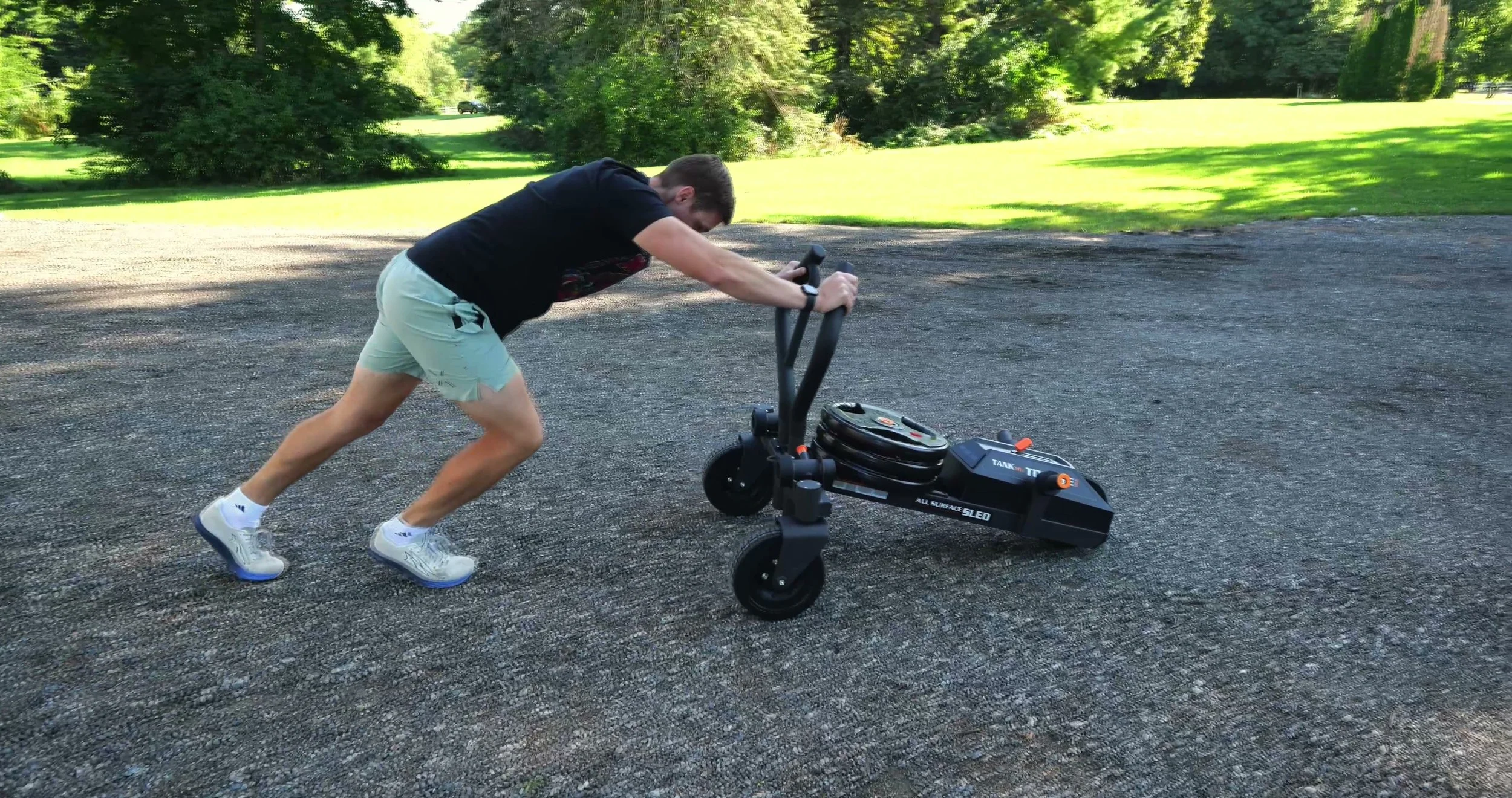
The basic training pattern is straightforward: push it, pull it, change the resistance, and repeat. I used it for hard 20, 30, and 40 yard push efforts, plus pulls using a rope attached to the post. I have also wrapped a rope or a squat belt around myself for pulls that let me create more space from the sled and avoid relying as much on my upper body. That gives me a practical way to include pushes and pulls in conditioning rounds alongside sprints, rowing, skiing, and other work.
Why the Magnetic Resistance Matters More Than Plate Loading
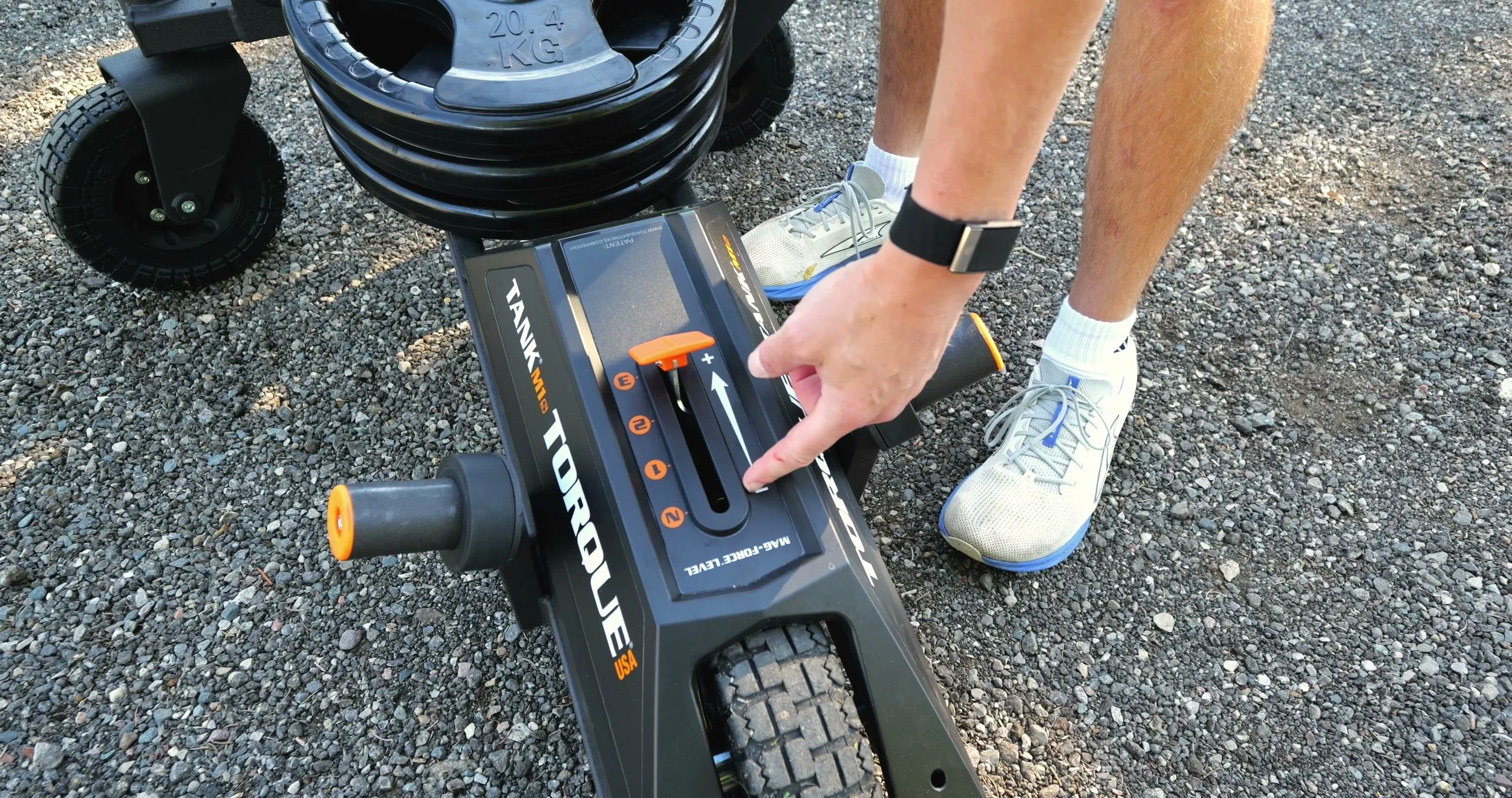
The feature that separates the TANK M1S from a typical wheeled cart is its magnetic resistance. The control has neutral and three resistance levels. In use, I mostly went to neutral or level three rather than treating every setting as equally important. At the higher setting, a hard push became hard enough that I could not keep moving quickly on the loose gravel because my shoes began to slip. On asphalt, I could push at roughly 90 percent effort and barely move forward. My legs and lungs were working, which is exactly what I want from short sled intervals.
That matters because rolling equipment gains momentum. If a wheeled sled has no meaningful resistance, simply adding plates is not always the clean answer once it gets rolling. Torque says its Mag-Force system increases resistance as you push harder; my experience was that it provided the hard, effort-responsive feel that makes a wheeled sled worthwhile for me. Plates still have a place here for added challenge and stability, but I found resistance, not plate capacity, to be the main limiter in normal use.
The Swivel Is Helpful, but It Changes the Feel
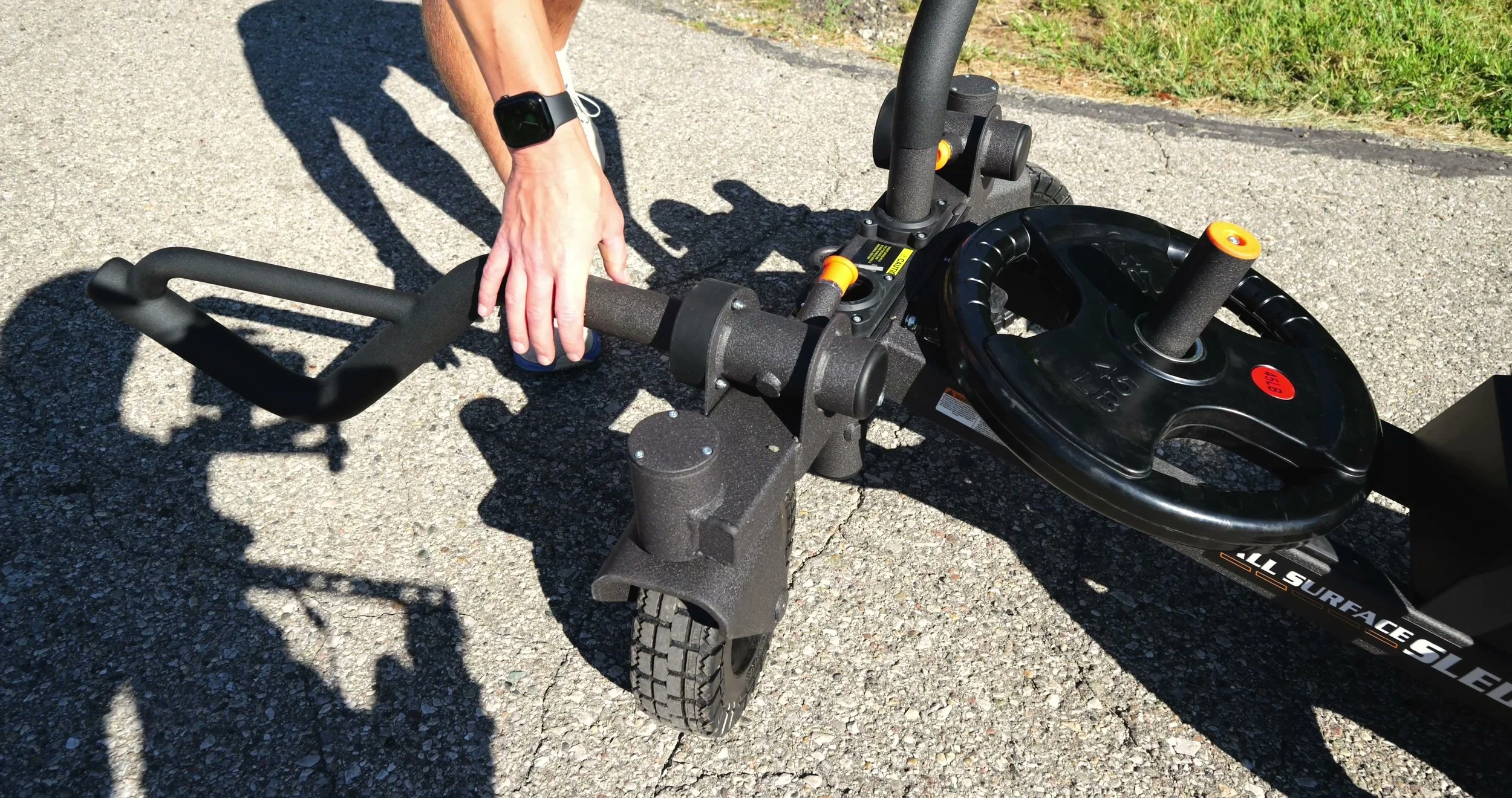
The M1S can turn quickly, which makes sense in a short driveway, a confined space, or any workout where you want to turn around and immediately pull or push back. Its handles also let me vary how I push, from a more extended position to a closer hand placement. There is a tow point for ropes and straps, and the integrated handle layout supports wheelbarrow-style movement. I tried that mode a few times, but it did not become a regular part of my own training; that is not a criticism of the feature so much as a reminder to buy for the movements you will actually use.
The tradeoff is steering stability. Because I could not lock the swivel wheels straight, small asymmetries in a hard forward push fed into the wheels. I found that distracting when I wanted to go hard in a straight line. A lockout option would make this version more appealing to me, but it was not present on the sled I used. The ability to turn is not a free upgrade for every user: it is most valuable when your space demands direction changes.
Build, Setup, and Space Considerations
The sled arrived mostly assembled in my experience; I only needed to install the front frame. The steel frame, textured powder coat, and overall fit gave me confidence that it was made for repeated use, but it is substantial enough that storage deserves real thought before buying. I did not leave mine outside in the rain, especially given the purchase price.
Torque lists the M1S at 50.5 inches long by 32.4 inches wide and recommends a 150-by-90-inch live area. That footprint is only part of the story. You also need meaningful travel distance and room to turn without clipping anything. The company lists an optional wall-mounted storage system for the standard TANK M1, while its M1S FAQ says the M1S is not compatible with that storage system. If you have a single-bay garage or need the easiest option to put away, that distinction is more important than it may sound on a product page.
Comparisons / Alternatives
TANK M1: This is the alternative I would reconsider for my own needs. The M1 retains Torque’s three-level magnetic-resistance concept and airless wheels but does not add the M1S swivel setup. Torque also offers a wall-mounted storage option for the M1. I initially wanted the M1S because I thought turning in my driveway would be essential; after using it, I would favor the M1 for straighter, more planted hard-effort pushes and easier storage planning. Choose the M1S when compact-space turns are a genuine priority, not just a nice-sounding feature.
Traditional plate-loaded skid sleds: Rogue, Titan, and many other companies offer much simpler plate-loaded sleds at a lower entry price. They make sense if you have turf, a suitable surface, or a training environment where skid wear and noise are not a problem. I would go this route when budget is tight and surface compatibility is already solved. It is not the solution I needed for loose gravel and neighborhood hard surfaces.
Xebex XT3 or XT4: These are other wheeled sled options worth comparing if you are already shopping in this price tier. I would compare the exact monitor, handle, accessory, storage, and steering configuration rather than assuming one name or spec wins for everyone. For my own use, the priority was simply getting outside for hard intervals without letting my training surface dictate the entire workout.
Tradeoffs
High entry cost: In my review, I described a typical M1S price of $1,299, with the supplied 5% offer putting it around $1,200 to $1,250. Treat that as review-time context, not a current price promise.
Surface is still part of the equation: The wheels work on my loose gravel, but traction, wheel skip, and footing were better on asphalt or concrete.
Swivel can wander under a hard push: Fast, straight efforts take more steering attention because there is no lockout on the model I used.
Storage is not an afterthought: It is a substantial sled, and the M1S cannot use Torque’s wall-mounted M1 storage system.
Accessories raise the total: The console, rope, strap, harness, and related accessories are separate unless a specific package says otherwise.
Who Should Buy This
Buy the TANK M1S if you want challenging push and pull intervals on surfaces where a skid sled is inconvenient, especially if you need to make quick turns in a driveway, garage, or small training area. It is also a good fit if you want the resistance to respond to how hard you drive rather than loading more and more plates. I found it especially useful as a conditioning tool that bridges strength work and hard cardio without needing a dedicated turf lane.
Who Should Skip It
Skip it if a basic plate-loaded sled already works well on your turf or preferred surface, or if the M1S price would leave too little room for the rest of your training setup. I would also choose something else if your priority is repeated straight-line sprint pushes, wall storage, or the simplest possible setup. In those cases, the standard TANK M1 or a conventional skid sled may be the more sensible buy.
Common Questions
Does the TANK M1S need weight plates to be challenging?
No. I found level three of the magnetic resistance challenging without treating plate loading as the main source of difficulty. Plates can add resistance and stability, but the Mag-Force system is the reason the sled can stay demanding as effort rises.
Will it work on gravel?
It worked on my very loose gravel, but it was not where I got the cleanest hard efforts. My shoes slipped and the wheels could skip when I drove hard. Concrete and asphalt felt more consistent; hard-packed dirt may also be more favorable than loose stone.
Should I get the M1S or the standard M1?
Choose the M1S if quick turns and 360-degree maneuverability solve a real space problem. Consider the standard M1 if you value straight-line pushes and wall-storage compatibility more. After testing the M1S, I would personally lean M1 for my own straightforward push-and-pull use.
Final Verdict
The Torque TANK M1S solved the problem I bought it to solve: it gave me a serious sled-training option outdoors when surface constraints ruled out a typical skid sled. The magnetic resistance is the standout, and the ability to push, pull, load plates, and turn quickly creates plenty of training options. Still, the cost is real, loose gravel is not as clean as hard pavement, and the swivel can work against you when all you want is a straight hard sprint. Buy it for multi-surface use and tight-space maneuverability; otherwise, take a serious look at the less complicated TANK M1 or a conventional sled that matches your surface.
CHECK PRICE — TANK® M1 AND M1S PUSH SLEDS. 5% discount auto-applied at checkout.
This article contains affiliate links. If you purchase through these links, The Jungle Gym Reviews may earn a commission at no additional cost to you.