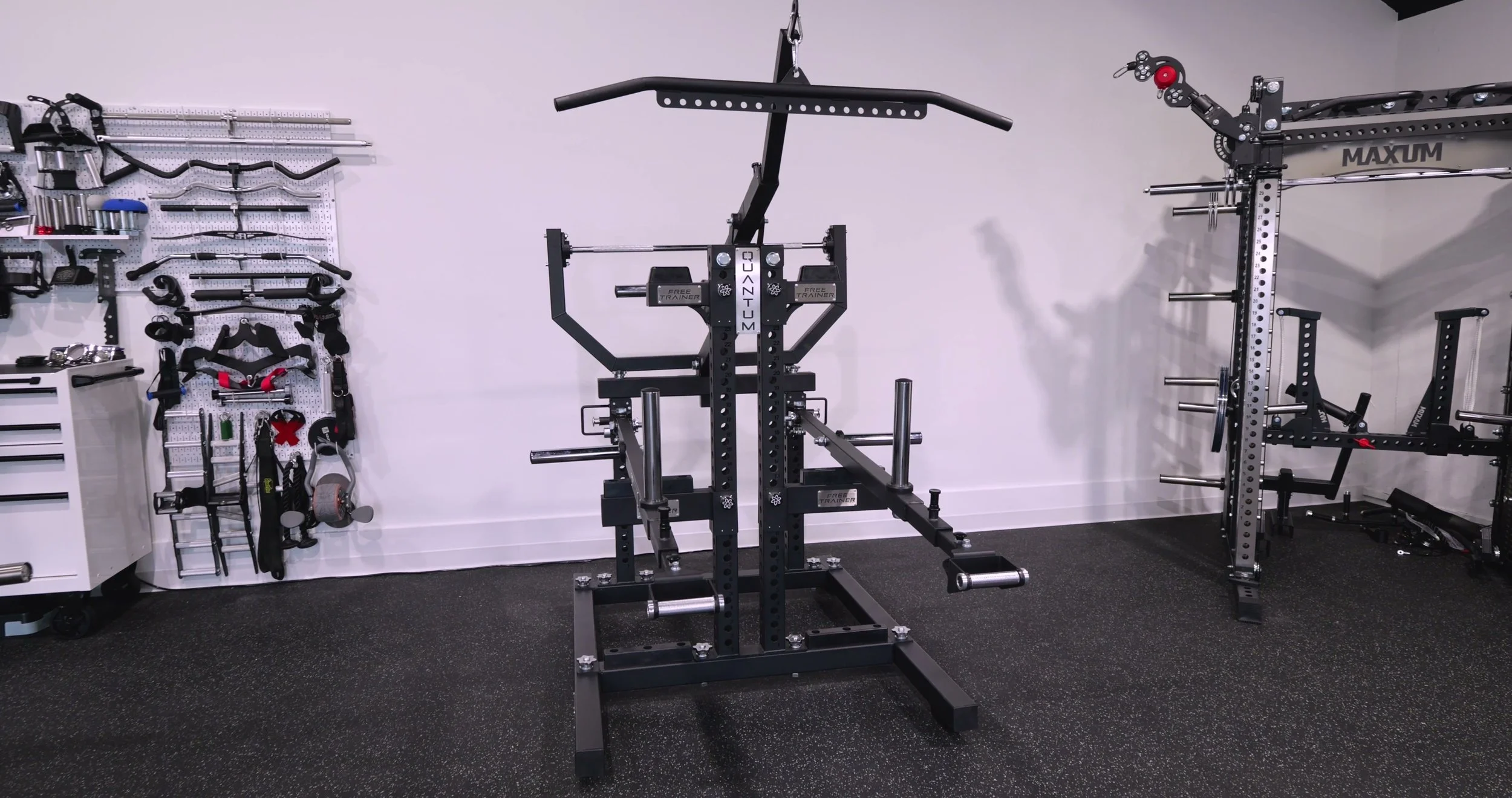
This product was reviewed in-house by Michael at The Jungle Gym Reviews.
The Quantum Free Trainer is an incredibly complex, highly versatile plate-loaded simulation station designed for home gym owners who want the ultimate all-in-one machine to replicate commercial gym movements. It features two independent, free-swinging lever arms that are adjustable in height, length, and handle type, allowing for an almost infinite variety of exercises. If you have the patience to set up the movements, this single piece of equipment can replace an entire circuit of dedicated machines.
Quick Takeaway
The Quantum Free Trainer offers unmatched versatility with its free-swinging lever arms, converging and diverging capabilities, and numerous attachments. While it requires time and thought to set up each exercise, it delivers an exceptional feel and arc for movements ranging from presses and rows to lat pulldowns and squats, making it a premium all-in-one solution for those who want commercial machine variety in a compact space.
Quick Specs
Price: $3,695 (US)
Availability: USA and UK
Footprint (Frame Only): ~5 feet deep x ~4 feet wide
Footprint (With Arms/Horns): ~7 feet deep x ~5 feet wide
Construction: 3x3 11-gauge steel with 1-inch hardware
Arms: Independent free-swinging lever arms with height/length and handle adjustments
Included Attachments: Multiple handle options, long and short spotter/start-stop arms with rubber bumpers, lat pulldown lever/leg rollers, low-row pulley/footplate, connected bar
Connected Bar Weight Capacity: ~700 lbs (approx.)
Key Capabilities: Converging/diverging pressing and rowing, plate-loaded lat pulldown and low row, barbell-style movements on a guided arc
Where to Buy
You can purchase the Quantum Free Trainer using the links below. Use code “JUNGLEGYM” for $50 off.
My Real-World Experience
I’ve spent a considerable amount of time with the Quantum Free Trainer because its capabilities are essentially open-ended. At its core are two independent lever arms that swing freely on bearings. Each arm can move up and down, but also left and right at the base thanks to a bearing shaft in the back. In practice, that means the arms naturally converge and diverge as you press or row, without you needing to fight a rigid path. The result is a feel that lands somewhere between free weights and a commercial machine. For my shoulders, wrists, and elbows, the ability to let each arm track where my body wants to go is a big win.
These arms also mount at multiple heights on the uprights. Changing the arm height changes the lever’s angle and therefore the resistance curve. I kept them set near the top for most of my testing to save time, but it’s there if you want to bias the arc for a specific movement. The same goes for handle length and angle, tweak those and the movement arc and perceived loading change again. Between unilateral and bilateral options, you can build your own machine for each exercise.
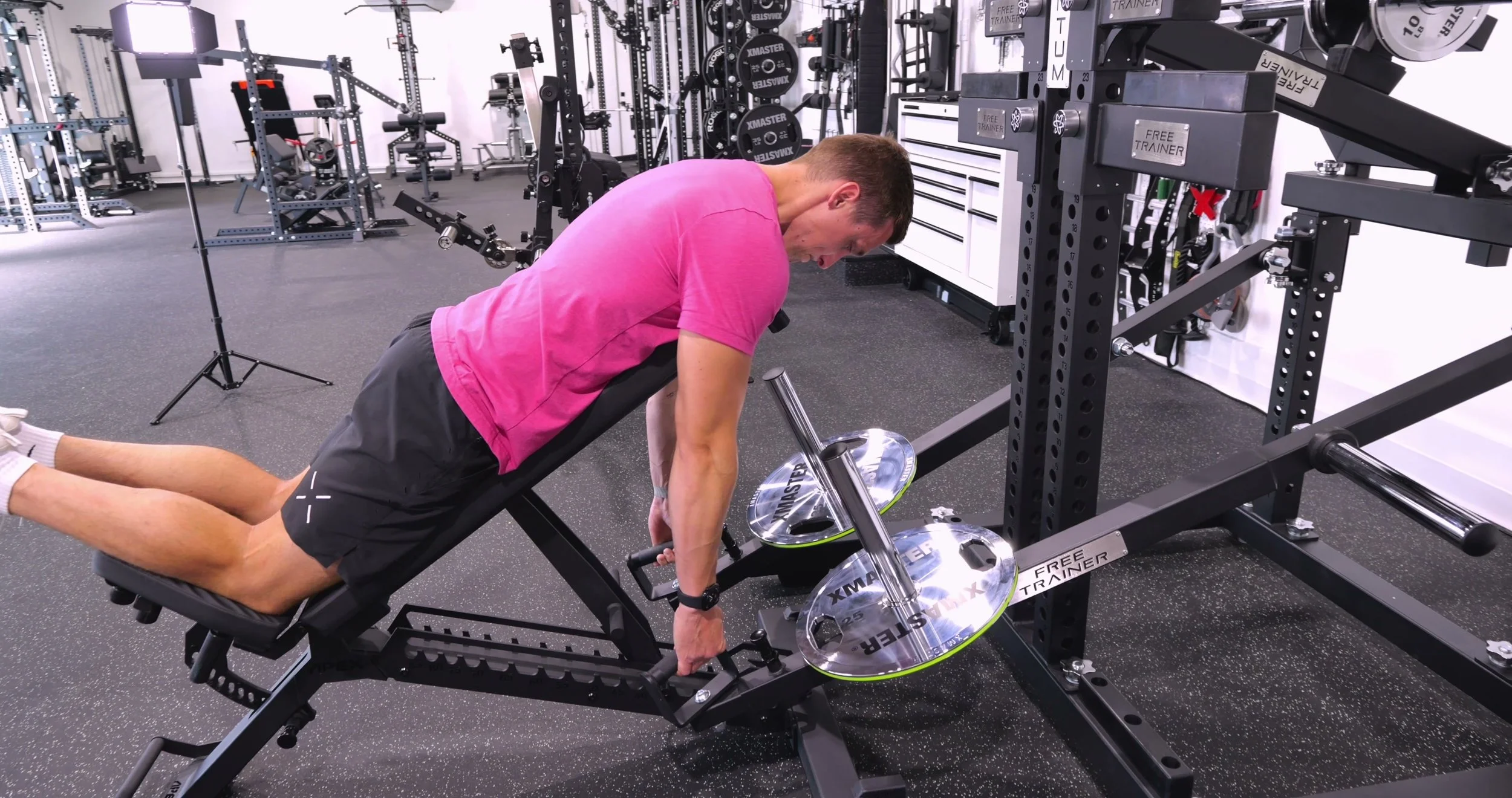
Because the arms are free-swinging, they don’t provide internal or external resistance the way some fixed-path machines do. They simply follow you. I experimented with banding the arms to the frame to add a hint of external resistance. It works, but it’s not seamless. Even without that, presses and rows feel excellent due to the natural convergence. On pressing especially, the arc and freedom of the wrists make the movement feel secure without being locked-in. If you like a touch of guidance without feeling pinned to a track, this is that middle ground.
Setup and Adjustability
Everything about this machine is modular. Nearly every component is bolted on with star nuts, and Quantum includes a small wrench so you can remove or relocate parts as needed. Weight horns can come off. The lever arms move up and down the uprights. The start/stop arms (two sizes are included) come off. Handles slide, rotate, and swap. You can reconfigure the layout to suit whatever you’re trying to do that day.
With that adjustability comes time. This is the honest tradeoff with multifunction systems in general. If you’re used to single-purpose machines or a selectorized stack, switching movements here will feel slower at first. You might move the arms, set the pop pins, change a handle length, swap a handle entirely, then load plates. It’s doable, but you need to plan the order of your workout so you’re not constantly reconfiguring. My best tip is to store the bar off the arms and keep your go-to handles nearby. Once I had a rhythm, changes took a minute or two.
On the day-to-day, I often “stage” the arms on the short start/stop arms with the rubber bumpers so they sit off the floor. With plates loaded, the rubber grips and the arms don’t slide. That makes it quick to bump the arm up or down a hole, then bring it back onto the bumper between sets. I was initially cautious about this around kids, but with weight on the arms, the setup is stable.
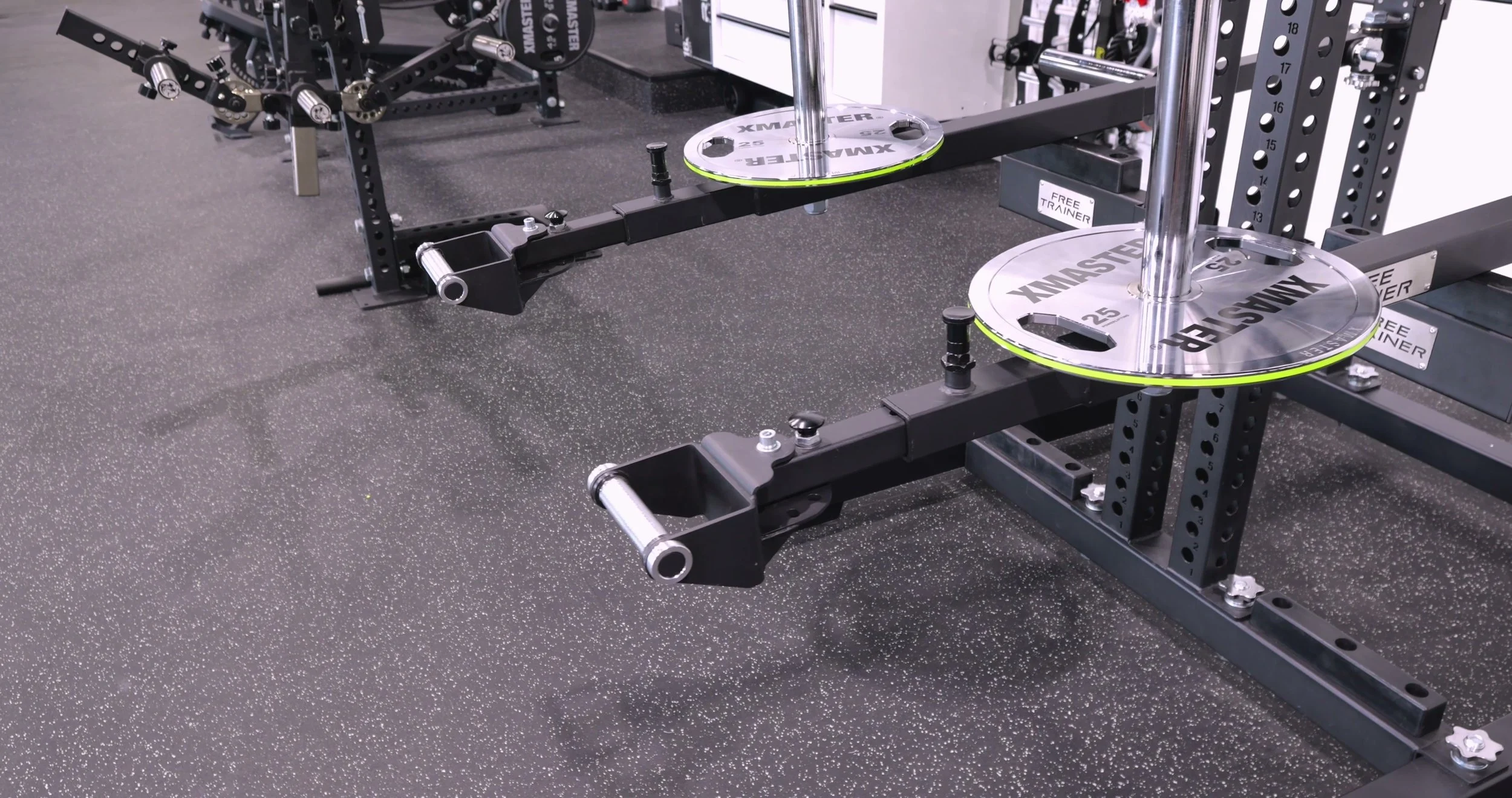
The handle system is deep. You get straight handles that slide on rails and lock with pop pins; I usually keep them around the second hole from the end, but you can bring them in or out to change the arc. The handles rotate and have multiple angle settings. I’d personally like one or two more angle options for some converging presses—when I’m fully in, my wrists sometimes want a slightly different angle. You also get a 360-degree rotating handle you can orient in different ways for things like rows, presses, or shrugs. There’s a landmine-style handle and another piece you can use for belt squats or as a connection point for cable attachments. The theme is the same throughout: decide your start/stop, length, and angle, and you can make almost anything work.
Two last setup nuances worth knowing:
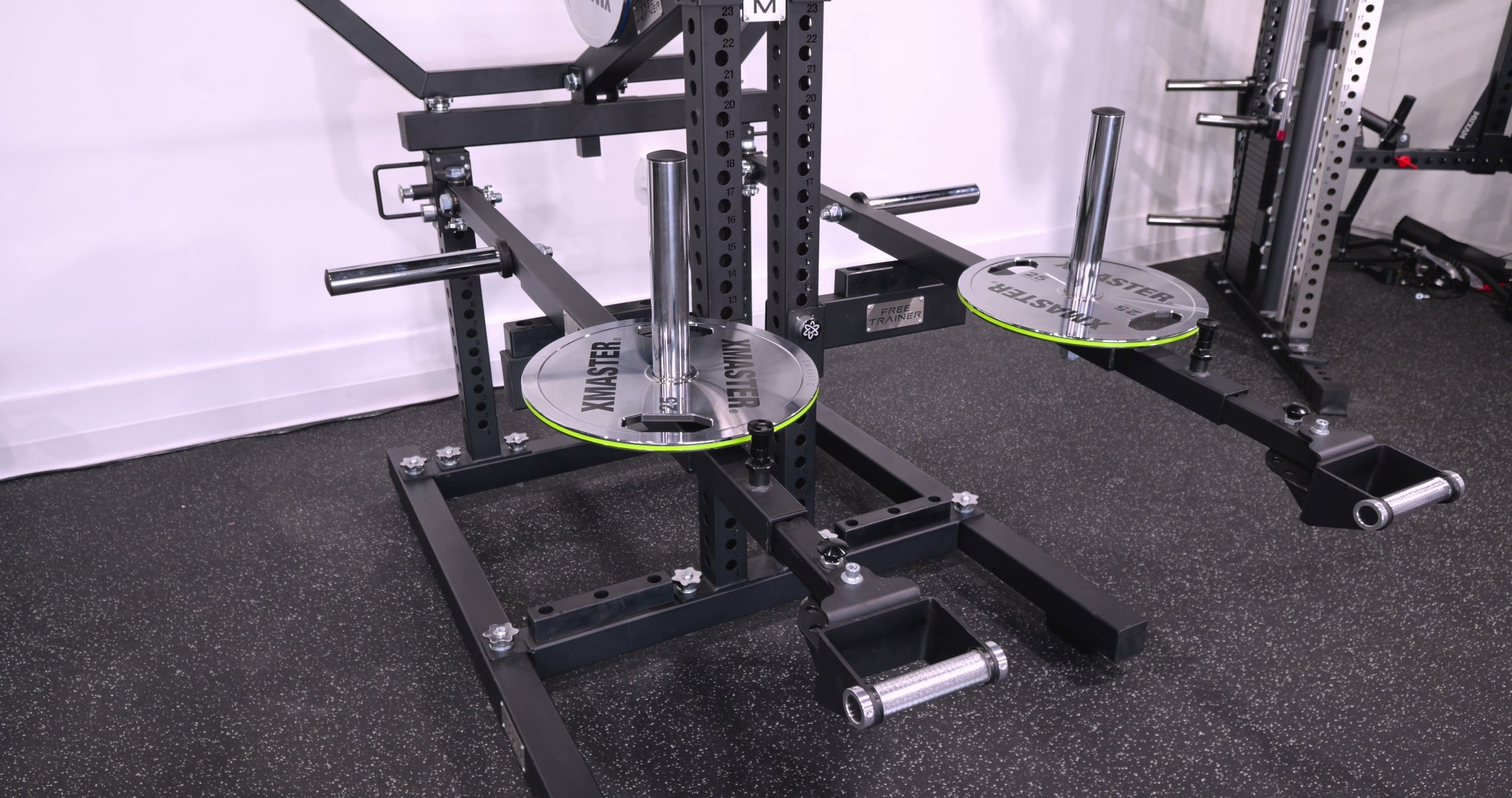
Plate collisions can limit your convergence when you load big 45’s on the inner horns. Staggering plates (small next to large on opposite arms) or using smaller-diameter plates helps.
There’s a spacer on the horns so plates don’t hit the frame, and there’s enough room between the horn and pop pin area to fit a full-size 45-pound plate.
Lat Pulldown and Low Row Integration
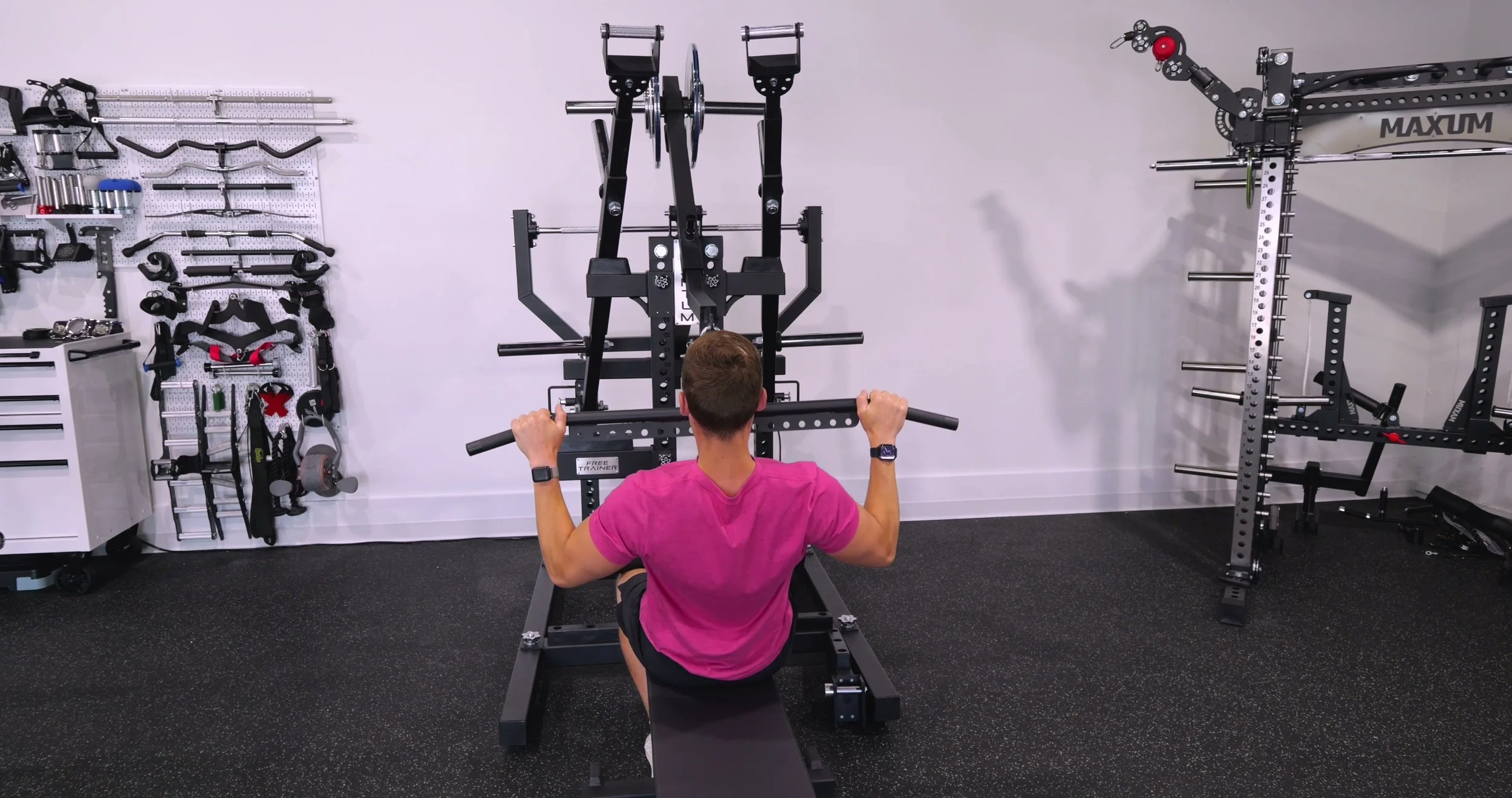
One of the surprises with the Quantum is how well it doubles as a plate-loaded cable system. A centering attachment mounts to the right upright and adds leg rollers for lat pulldowns. The lat lever arm itself has two mounting positions so you can pick the arc and resistance curve you prefer. I like the longer setting. Because it’s plate loaded, the resistance is highest around parallel to the ground and tapers slightly as the plates rise. That taper lets you sink into the fully shortened position at the bottom of the pulldown, think of it like a subtle pull-over finish where you can bring the bar down and in with a full stretch and hard contraction. The first time I did pulldowns on this, the pump made it clear that the arc and taper were doing something right.
When you’re done with pulldowns, the same centering attachment accepts a low-pulley cable and a multi-angle footplate for seated rows. There is a small quirk: due to where a mag pin sits, the pulley can’t mount absolutely flush at the bottom, so it rides a little off the floor. It’s still usable on the ground (I did it that way plenty), though you can also pull up a bench to fine-tune the angle. The footplate has multiple angle adjustments to find a comfortable shin and ankle position. As with the pulldown, the plate-loaded lever effect slightly tapers resistance at the back of the row, which helps you reach that last inch or two of range without overstraining the end position.
Beyond pulldowns and rows, you can route the included cable high or low for accessory work. I used it for triceps pushdowns, biceps curls, and single-arm laterals. It’s not a dedicated selectorized stack, but the feel is smooth and the range is there when you set it up thoughtfully.
The Connected Bar
The connected bar links the two arms so you can perform barbell-style movements on a guided arc. Setup takes a bit of choreography. You’ll want to bring both arms to roughly the same width, lift the bar into the cradles, pull the pop pins, slide the bar until both pins line up, then click them in. It usually requires a small shimmy left or right to seat both ends. Once it’s locked, the bar spins on bearings so your wrists aren’t forced into a fixed rotation.
Every barbell movement you do on the Quantum follows a slight arc that depends on where you mounted the arms and where you set the starting length of the handles or bar. For squats, that arc was a major advantage for me. With my feet a touch forward and the arms set high, the path feels like a light pendulum-squat hybrid that invites a deep bottom position. I could sit into depth comfortably, and the small degree of guidance helped me groove my stance. For pressing, the arc lets me choose to face toward or away from the machine and still get a natural, converging press that feels secure without being locked to a single plane.
Comparisons / Alternatives
At around $3,695, the Quantum Free Trainer lands near the price of a high-end power rack with a selectorized stack (often $3,500–$3,800). That alternative offers faster weight changes and a familiar cable experience. The Quantum, on the other hand, is a different animal. The free-swinging lever arms create converging and diverging arcs that you can configure endlessly, and it switches between lever-based presses and rows, a plate-loaded pulldown and low row, and even barbell-style training via the connected bar. To my knowledge, there isn’t another single machine that combines all of these functions with this degree of freedom at this price. It’s not about being better than a rack-with-stack—it’s about whether this style of lever-driven, build-your-own-arc training is what you actually want in your space.
Tradeoffs
Time is the main tradeoff. The more a machine can do, the more you need to think through setup. If you want true “walk up and go” speed between every movement, a dedicated machine or selectorized stack will be faster.
The second tradeoff is path: you cannot lock the lever arms into a rigid plane. They’re designed to swing and follow you. There’s no internal/external resistance built into that arc, only the vertical loading from the plates. You can rig bands to bias the arms in or out, but it’s not a built-in function.
There’s also some expected “play” in quick-adjust components. Mag pins and sliding handles are fast, but they won’t feel as zero-tolerance as a threaded knob cinched down tight. That minor wiggle is the cost of speed. None of this affects structural strength: the frame is 3x3 11-gauge steel with one-inch hardware and stout brackets. From a durability standpoint, it’s overbuilt. If you’re after polished finishes, boutique knurling, or premium powder on every edge, this isn’t trying to be that—and that helps keep the price in check given how many parts are included.
Two practical notes round out the tradeoffs:
Large plates on the inner horns can bump into each other on converging presses. Stagger plates or use smaller diameters to maintain clearance.
For the low-row pulley, the pin geometry keeps it a bit off the floor. It’s still very usable; just know you may want a bench for your preferred angle.
Who Should Buy This
If you want commercial-machine variety without lining your wall with single-purpose units, this is the one-footprint answer. It’s also a strong complement for lifters who already have a barbell, bench, and dumbbells but miss machine-style arcs for presses, rows, pulldowns, and leg work. If you enjoy tinkering with setup and see the process as “building your machine” for the movement of the day, the Quantum will reward you with excellent feel and near-endless variation.
Who Should Skip It
Skip this if you hate setting up equipment between exercises. If your priority is a fast, fixed-path experience, selectorized stacks and dedicated single-use machines, you’ll likely find the Quantum’s setup time and free-swinging arms frustrating. It’s also not for someone who wants a rigid, locked plane for every movement.
Common Questions
Does the Quantum Free Trainer lock into a fixed path?
No, the lever arms are free-swinging on bearings, meaning they move up, down, and left to right. They naturally converge and diverge based on your movement, but they cannot be locked into a rigid, single-plane path.
Can I use standard attachments with it?
Yes. The frame uses 3x3 11-gauge steel with 1-inch hardware, which matches the home-gym industry standard. You also get multiple handles, the lat pulldown setup, the low-row cable/footplate, and the connected bar included.
How much space do I need for it?
The frame itself is about 5 feet deep by 4 feet wide. With the arms and weight horns, plan for closer to 7 feet deep by 5 feet wide, plus room for you and a bench in front.
Final Verdict
The Quantum Free Trainer is a remarkably engineered, highly modular system that truly lives up to the “all-in-one” claim. It asks more of you in setup and planning, and it won’t lock you into a rigid path. In exchange, you get a machine that can be a converging chest press, a unilateral row, a deep-feeling squat on a guided arc, a plate-loaded lat pulldown, a low row, and a cable station, often in the same session. The arc feels natural, the independent arms let your joints choose their track, and the range of adjustments makes true variation possible in a home gym.
If you want commercial machine versatility in a single footprint and don’t mind tinkering with your setup, this is the machine to get.
Use code “JUNGLEGYM” for $50 off your purchase.
The Jungle Gym Reviews may earn a commission if you purchase through our links, which helps support our independent testing.