GetRX’d RX3 Power Rack Attachments Review
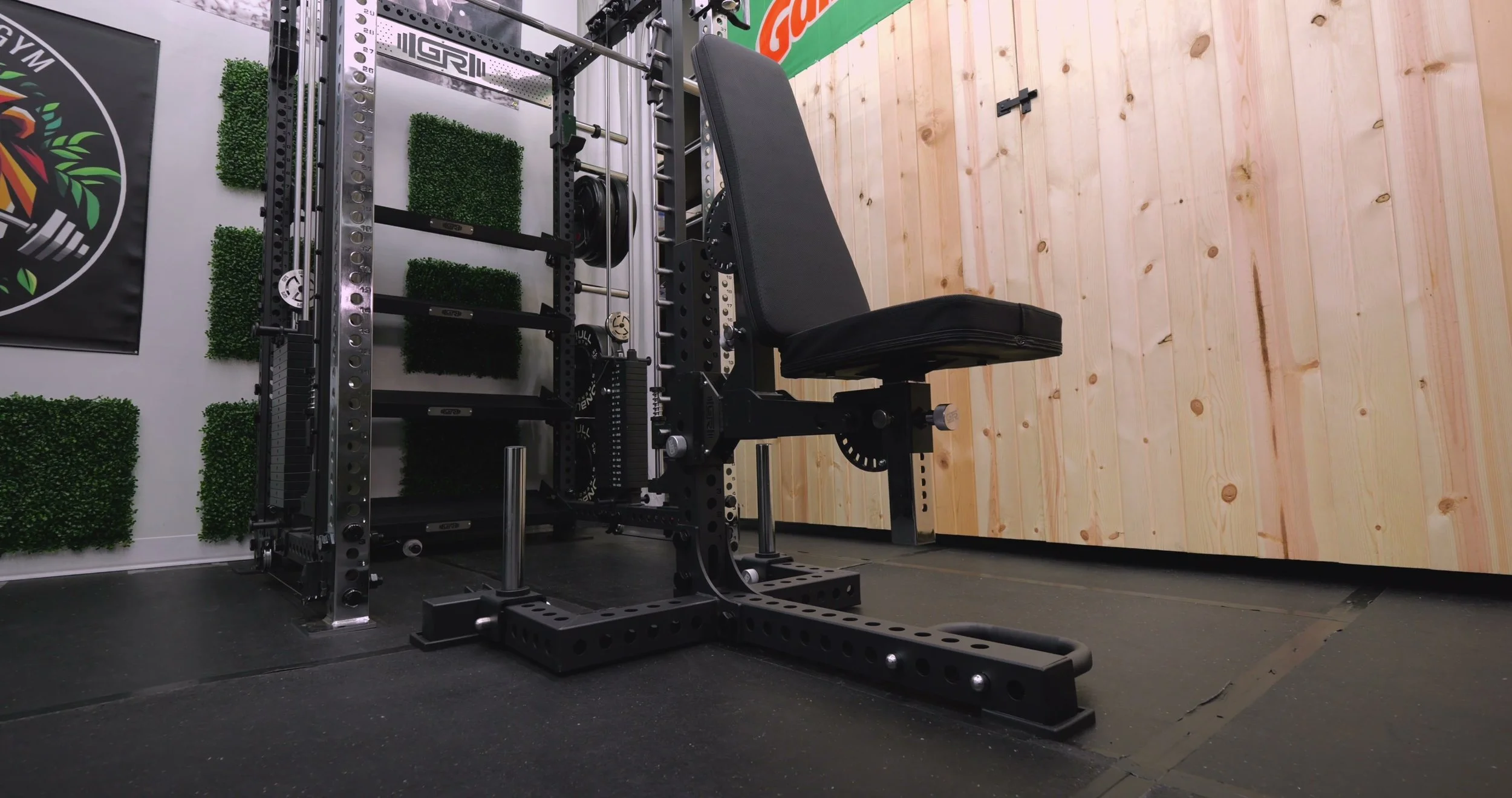
These products were in-house tested by Michael at The Jungle Gym Reviews.
GetRX’d just released a new RX3 attachment lineup built around their metric 3x3 rack system with 1-inch holes, and the concept is simple: make your rack do more without turning it into a permanent “one-purpose” station. The Center Post Attachment is the standout because it unlocks truly centered, rack-based cable and pad work that normally takes a dedicated machine or a bunch of compromises. The main hesitation is compatibility—anything with a second locking point is a problem on imperial hole spacing—and the other real cost is setup time and storage.
Quick Specs
System Type: Metric 3x3 rack attachments
Hole Size: 1”
Fit Note: Designed for GetRX’d RX3 (metric hole spacing)
Key Attachments Covered: Center Post Attachment, Optimus Pad, Optimus Leg Roller, Optimus Back Pad (Military Pad), Lat Pulldown & Low Row Pad, RX3 Military Bench Frame
Optimus Pad + Leg Roller Price: $255 before shipping ($300 delivered in my case)
Comparable Products Mentioned: REP Fitness Pegasus, Rogue Monster Utility Seat (~$400)
Tornado Stack Note: 210 lb stack, 2:1 ratio (105 lb at handle max without add-ons)
Where to Buy / Check Price
Check current pricing and availability on the official product pages.
My Real-World Experience
GetRX’d has released a new line of RX3 attachments designed for their metric 3x3 rack system with 1-inch holes, and the big takeaway is that this lineup is built around making your rack more modular instead of forcing you into a single fixed setup. In practice, the ecosystem feels like it was designed by someone who actually uses a rack as a rack, but still wants dedicated-machine functionality for pulldowns, low rows, flyes, and chest-supported work.
The attachment I’m most excited about is the Center Post Attachment—an L-shaped tube that creates a short vertical post perfectly centered between your uprights. That centered location matters more than it sounds like it would. Once you’ve done a few movements with something truly centered (instead of “kind of centered” on one upright), you realize how many exercises get easier to set up, feel more natural, and have better range of motion when you’re not fighting the geometry of a single upright.
The second “this is smarter than it looks” piece is the dual-function Lat Pulldown and Low Row Pad. It’s a leg holder for pulldowns, then it flips down (pop pin) and becomes a metal foot brace for low rows. That solves a home gym problem I run into all the time: I don’t want to drag a bench in, wedge it, then still not have a great foot brace for heavier rows. This is more direct and more repeatable once you get a workflow for mounting it.
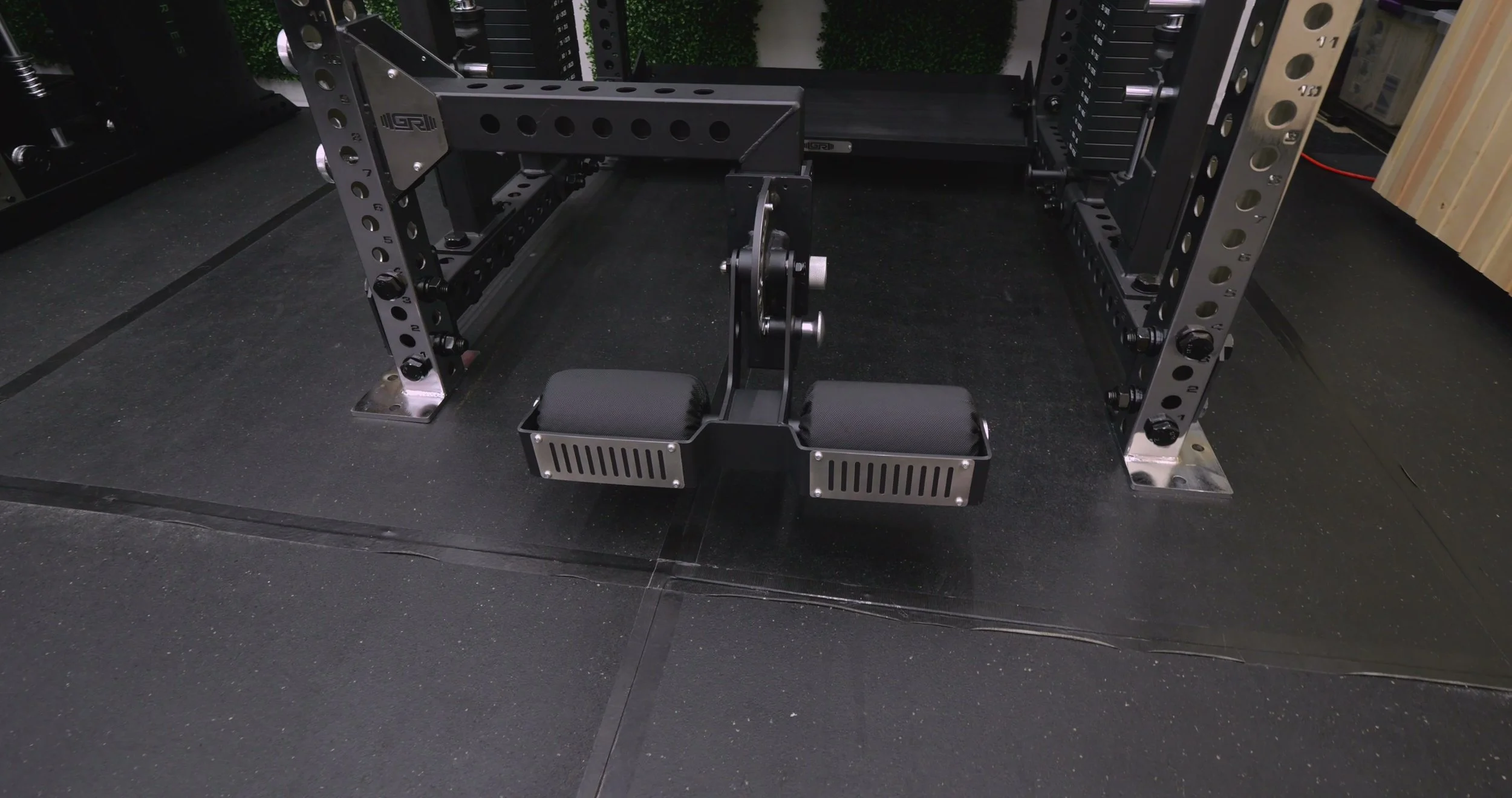
The centerpiece, though, is the Optimus Pad. At its base it’s a chest support / lat pulldown seat. Then it has an attachment tube that accepts add-ons—either leg rollers for pulldowns or an adjustable military bench back pad. The value is that it’s not just one thing. It’s a seat, it’s a chest pad, it can become a back pad, and it’s designed to lock down hard enough that you don’t feel like you’re balancing on an accessory.
The Optimus Pad: What It Does Well
The Optimus Pad uses a big mounting bracket that attaches to any 3x3 tube. They include magnetic hitch pins (second hole) plus a threaded knob. Between the pins and the threaded tension points, once you tighten it down, it feels secure—even when you’re putting real force into it.
Adjustment is a big part of why it works. The seat pad can angle all the way to vertical so you can use it like a back pad if you pull a bench up for military press work or chest-supported rows. It also goes slightly past 90 degrees, which lets you set an angle that forces you down toward the rack—useful for certain pulling movements where you want to feel “locked” instead of floating.
You’ve also got roughly six to seven inches of height adjustment across multiple positions, so you don’t have to nail one exact rack hole to make it usable. That’s a small detail, but it makes setup more forgiving in the real world.
Optimus Leg Roller: Turning It Into a Real Lat Pulldown Seat
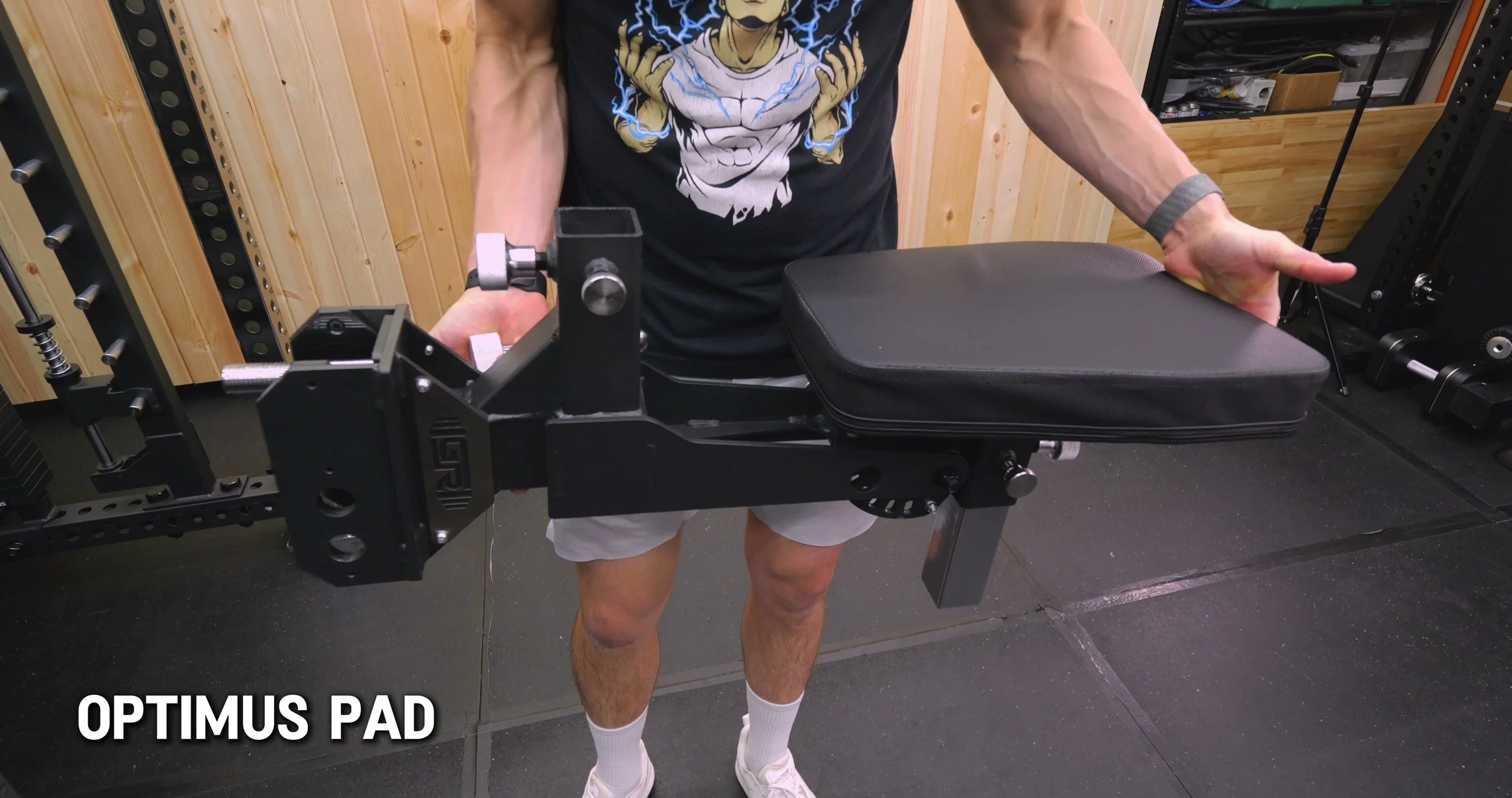
The Optimus Leg Roller add-on uses the same basic approach: pop pin plus a side knob, both threaded. Tighten them down and it stays fixed. Once that’s on, you’ve got a proper lat pulldown seat setup that competes with higher-priced “utility seat” type products.
I called out the REP Fitness Pegasus and the Rogue Monster Utility Seat as rough equivalents in terms of what they enable, and those are typically around $400. The Optimus Pad plus Leg Roller came out to about $255 before shipping, and for me it was around $300 delivered (GetRX’d charges shipping). That’s meaningful savings, and you’re not buying into a dead-end piece—because here the same base system accepts multiple add-ons.
One practical note: if you’re doing heavy lat pulldowns using the RX3 Tornado rack’s selectorized system, keep the ratio in mind. The stack is 210 pounds and it’s a 2:1 ratio, so you’re capped at about 105 pounds at the handle without adding plates. For truly heavy single-arm work, you’ll likely want a weight stack adder pin and Olympic plates.
Optimus Back Pad: Where It Makes Sense (and Where It Doesn’t)
The Optimus Back Pad (Military Pad) turns the Optimus seat into a narrow adjustable back pad for dumbbell flyes, presses, and similar work. In my experience, it becomes most functional when paired with the Center Post Attachment—especially for movements like chest-supported cable rows where being centered matters.
If you’re trying to use it off a single upright, I don’t think that’s the strongest use case. It’s not that it doesn’t “work,” but this pad feels like it was designed with center-mounted positioning in mind.
The Center Post Attachment: The Standout
The Center Post Attachment is the coolest piece here, and it’s also the cheapest attachment that provides the most value. You don’t need to buy into a bunch of other things to get benefit out of it. If you already have cable handles, pads, or creative setups at home, the center post becomes the anchor point that makes them better.
There is an important compatibility reality here: these are metric 3x3 attachments made for RX3. Anything that uses two mounting holes will not fit imperial racks correctly because the hole spacing is different, and the second hole won’t line up. Even on something like the Military Bench Frame, the secondary mag pin can get stuck and won’t go through fully on an imperial rack, which means you lose that secondary locking mechanism.
I’d like to see GetRX’d address that in the future. The most obvious solution is to elongate the second mounting hole instead of keeping it perfectly circular. That would give enough tolerance to work across imperial and metric spacing. I’ve seen other companies do variations of that, and it’s a practical way to make “mostly compatible” become “actually compatible.”
One more fit note: the Center Post is designed to be exactly centered on a 42-inch interior width—this matches GetRX’d and Titan Fitness racks. If you’ve got a REP rack, it’s metric, but it’s 41 inches interior, so you’ll be slightly off center. In the real world, that’s not a big deal, but it’s worth knowing what you’re getting.
Lat Pulldown + Low Row Pad: The Two-in-One That Actually Matters
This is the attachment that turns the center post into a real “station.” The pad flips between two functions: leg hold for pulldowns and foot brace for rows.
The foot plate has roughly 180 degrees of angle adjustment across about eight or nine increments, which gives you a lot of flexibility to match different row heights and cable paths. Drop the center post lower, plant your feet, and you’ve got a repeatable low row setup that doesn’t rely on improvising with plates or a bench.
When you’re done, rotate it back so the metal bracket is out of the way and the rollers serve as your leg holder. The rollers are soft, dense, and comfortable—comparable to what you’d expect on a commercial pulldown pad.
If you don’t need a dedicated lat seat and you just want a better low row setup (or you’re fine using a bench for seated work), this is one of the most “buy it and immediately use it” pieces in the lineup.
RX3 Military Bench Frame: When You Want Distance From the Rack
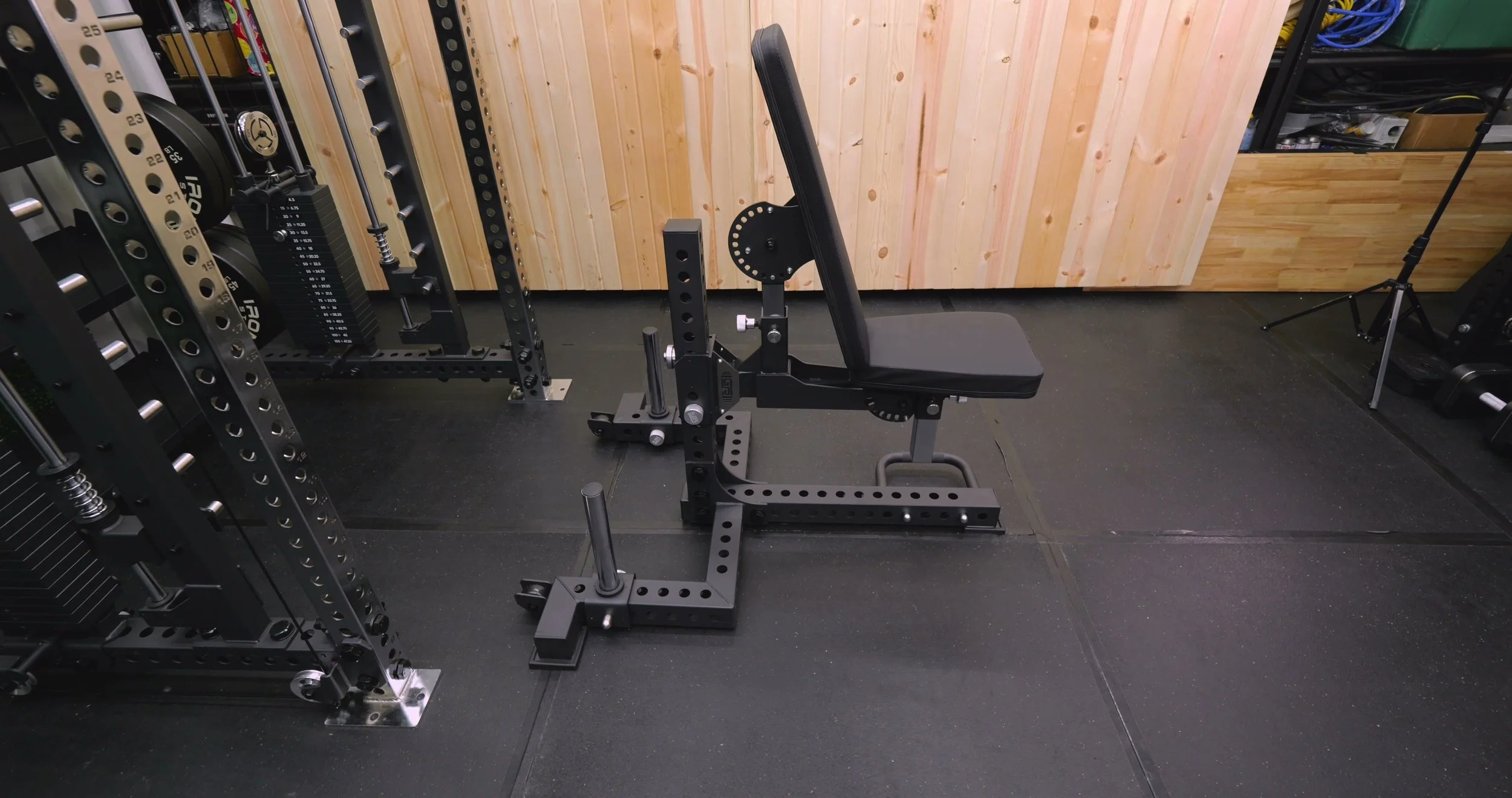
The Military Bench Frame is less of an “attachment” and more of a freestanding mounting platform for the same modular pieces. The center post is great when you want to be centered, but sometimes you want distance—one, two, or three feet away from the rack—for better cable angles or just more breathing room.
Yes, you can pull up an adjustable bench, but benches move. If you want something heavy, locked-in, and purpose-built, that’s where this frame fits. It’s a standalone 3x3 platform with 1-inch holes, removable weight horns so you can load it down, and built-in wheels so you can roll it in and out.
For me, this frame is less useful for lat pulldowns or low rows because the center post handles those better. Where it shines is paired with the military back pad farther from the rack, especially for cable work like chest-supported rows, flyes at different angles, and single-arm lateral raise variations where you want a big stretch and clean line of pull.
Tradeoffs and Limitations
The biggest con is setup time and the “home gym reality” of storage. These attachments are modular, which means you have to think ahead: what are you doing next, where does the pad go, where do the rollers go, where do you lean the center post without it being in the way. That’s the tradeoff for making one rack do more jobs.
The other limitation is compatibility. If you’re on an imperial 3x3 ecosystem and you’re hoping to mix-and-match, anything with a secondary hole lock is going to be an issue. If GetRX’d solves that down the line, this lineup becomes even more compelling outside of the RX3 world.
Value and Alternatives
From a value standpoint, the Optimus Pad + Leg Roller pricing is hard to ignore compared to other “utility seat” style solutions that land around $400. But the bigger value here is ecosystem flexibility: you’re not just buying a seat. You’re buying a base that accepts other tools and can be used in multiple configurations.
If you want the most bang for buck, the Center Post Attachment plus the Optimus Pad setup (and that lat/low row piece) is where the system really clicks. The Military Bench Frame can be useful, but a lot of people can get most of the same outcomes by using an adjustable bench and being willing to accept a little movement.
Who Should Buy This
If you have an RX3 rack (or a compatible metric 3x3, 1-inch hole rack) and you want to add real station-style capability without buying separate machines, this lineup makes a lot of sense—especially if you care about centered cable work and repeatable setups.
Who Should Skip It
If you’re on an imperial 3x3 ecosystem and the pieces you want require a secondary mounting point, you’re going to run into alignment issues. Also, if you hate accessory setup time and want everything permanently ready to go, modular attachments like this can feel like friction.
Final Verdict
The Center Post Attachment is the star, the Optimus Pad system is the backbone, and the lat/low row attachment is the practical “daily use” piece that makes the whole system feel like more than just a collection of accessories. Setup time is the main annoyance, but in terms of functionality, adjustability, and build quality, I’ve had zero issues. The only real improvement request is broader imperial compatibility in future revisions.
Affiliate Disclosure
This article may contain affiliate links. If you purchase through these links, The Jungle Gym Reviews may earn a small commission at no additional cost to you.